Building communities

About

Our Heritage

With decades of experience working with traditional building materials — including wood, block, ICF, SIPs, and others — we knew there had to be a better way to build. The truth is, the residential construction industry has seen very little innovation in decades. It’s surprising, considering we’ve essentially been building the same wood-framed structures since their origin in 13th-century England.
The concept of the modern Structural Insulated Panel (SIP) began in 1935 at the Forest Products Laboratory (FPL) in Madison, Wisconsin. Between the 1930s and 1950s, two key figures helped shape the SIP industry: famed architect Frank Lloyd Wright Sr. and one of his students, Aldon B. Dow, the son of Dow Chemical’s founder. Their work led to the development of the first foam-core SIP products in 1952 — panels still used today, primarily in residential and low-rise construction. Since then, advancements in foam insulation, Oriented Strand Board (OSB), Computer-Aided Design and Manufacturing (CAD/CAM), and general technology have driven continued growth in both OSB and metal SIP panel technology for over 60 years.
Carrying forward the efforts of those who came before us, we set out in the early 2000s to build stronger, safer, and more durable structures — while reducing waste and maximizing energy efficiency. Though our journey continues, we’ve made significant progress. In 2018, we were awarded our first utility patent (#9,624,666) for a unique and innovative building envelope technology, and the KRATOS™ Building Solution was born.

Our Value Proposition

We believe true sustainability requires a balanced approach between cost and benefit. Focusing only on cost, or solely on environmental impact at any expense, isn’t truly sustainable over the long term. Unfortunately, many builders today prioritize the lowest initial build cost, doing only the minimum to meet code in order to maximize profit. While this approach may satisfy short-term ROI goals for investors, it often works against the best interests of the buyer — who is seeking a durable, healthy, efficient, and cost-effective home. In other words, the builder’s goals and the buyer’s goals are often directly at odds, especially with large national homebuilders.
While initial construction cost is certainly important, one of the most significant — and often overlooked factors in building or buying a home are the operational costs over the life of the building. This is referred to as Total Cost of Ownership (TCO), and it includes ongoing expenses such as utilities, insurance, property taxes, maintenance, and repairs. Considering TCO as part of the decision-making process, and the sustainability equation, is essential, as these long-term costs directly impact overall affordability and value.
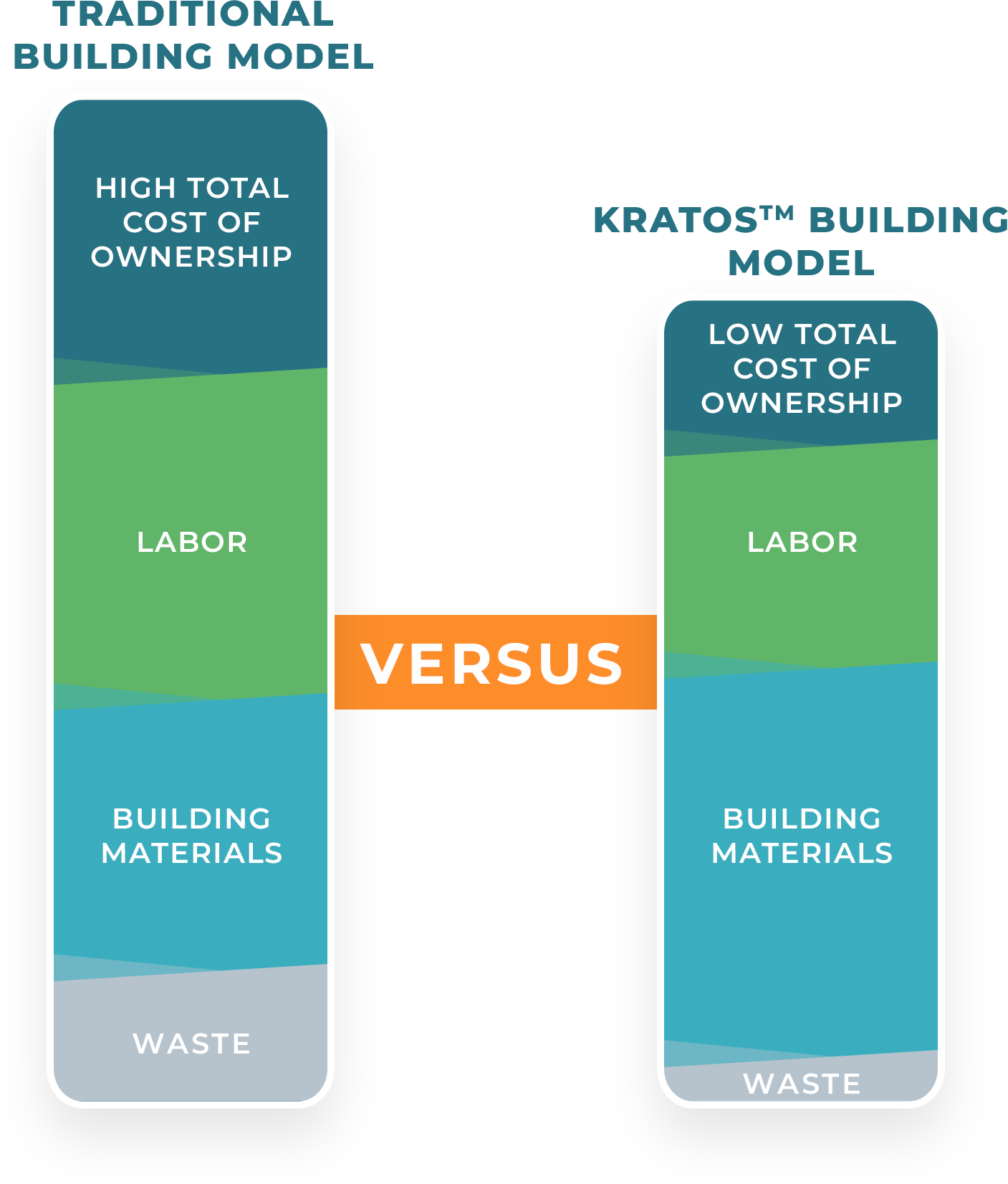
The key to building a truly sustainable structure lies in achieving both environmental and financial sustainability together. That means building higher-quality, more energy-efficient homes that are also more economical to operate — all while reducing waste and minimizing environmental impact. The result? Less material waste sent to landfills, lower CO₂ emissions, reduced maintenance and repair costs, decreased utility bills, and lower insurance premiums — all contributing to a lower TCO for the owner or occupant. See below to compare how our sustainable model measures up against traditional building methods.

Build To Code:

Build To Perform:

Resolution:

Bottom header:

The above model demonstrates the possibility of accomplishing both financial and environmental sustainability by shifting the costs of labor over to better materials and technologies, like our light gauge steel KRATOS Wall Solution, to build a better higher quality structure that is energy efficient, safe, resistant, durable and environmentally friendly (i.e. use of recycled materials, recyclable waste of less than 2% with Co2 capture, low/no VOC’s). In turn, this higher quality structure provides for savings to the owner/operator in lower utility bills (i.e. 60% to 80% in energy savings), maintenance, insurance and repairs over an extended lifespan of the structure. This savings can even be used to fund a higher initial build cost and yet over time facilitate a shorter and lower cost of financing, or faster return on investment. Additionally, our structures are considered “green buildings”, and easily meet the EPA’s Energy Star program, Green Building Coalition programs, LEED and other program requirements for green building certifications. These certifications often pay for themselves with Federal financial incentives, while providing a platform for green building loans and increased property values. This is true sustainability, and something we do every day.

Thank you for taking the time to learn more about who we are and our vision for the future. We hope you will engage and join us on this important journey towards a brighter and greener future!

Todd Wright

Co-Founder & President

Partner with us today in helping to build a more sustainable future.

Our building technology can be used to build almost any type/style of structure. Value Engineered for specific wind/seismic design criteria, combined with an adjustable r-value, insulated exterior wall, our wall system is the perfect solution for any climatic region in the World. Past and current projects have spanned from Alaska to the Caribbean Islands and include residential, commercial, emergency and institutional type projects.